Boulder City's Lost Airport

Once known as the "biggest airport in the West", very little remains of the Boulder City Airport today.

Historic Boulder City Airport in Southern Nevada

After exploring the Boulder City Pet Cemetery on the outskirts of town, I made my way into the city to check out several other abandoned places. First on the list was the original Boulder City Airport.

It opened in November 1933 as Bullock Airport, named after Noel Bullock, who leased the land from the Bureau of Reclamation. Originally a private airstrip with no hangar, it served as the base of operations for Bullock's charter service and sightseeing tour business.

Boulder City Airport in Southern Nevada
Flyer for Bullock Airport (source: http://www.airfields-freeman.com)

Bullock died about a year later, in December of 1934, when his plane crashed into the Pacific Ocean while carrying passengers from Mazatlan to La Paz, Mexico.

In 1936 a primitive terminal building was added to the property and Grand Canyon Airlines became first commercial airline to operate out of the airport. Unfortunately the airline failed to achieve financial viability. In 1938 TWA leased the airport and a new terminal with upgraded amenities was built.

Historic Boulder City Airport in Southern Nevada
Opening of the TWA terminal in April 1938 (source: http://www.airfields-freeman.com)

The Boulder City Airport became an important transportation hub for tourists visiting Lake Mead National Recreation Area, Hoover Dam, Las Vegas, and the Grand Canyon. For a time, it was known as "the biggest airport in the West." 

During World War II, civilian flights were limited and the airport was primarily used for military planes. The opening of McCarran airport in Las Vegas caused a considerable decrease in the number of civilian flights into Boulder City.
Boulder City Airport in Southern Nevada

TWA ceased operating out of Bullock's Field in 1949 when the airport was condemned by the CAA.

In 1958, Boulder City Elks Club bought the main terminal building and transformed it into their club house. It is still used for that purpose today.

Boulder City Airport reopened under city control in 1961 after renovations were made.
Historic Boulder City Airport in Southern Nevada
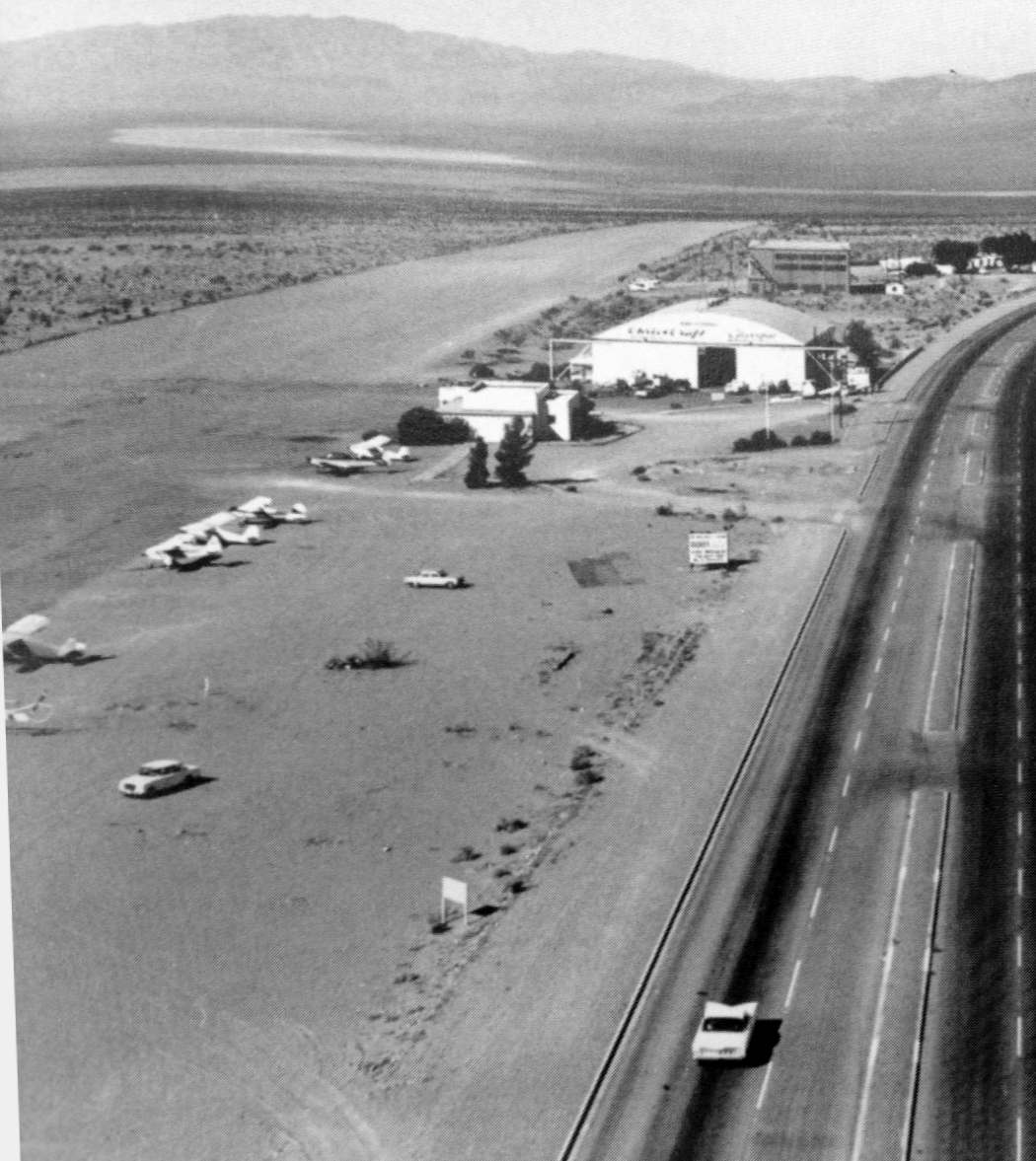
Aerial view of Boulder City Airport in 1962 (source: http://www.airfields-freeman.com)

The airport property shrunk over the years, decreasing from 3 runways to only 1 by 1980.

Construction began on the new Boulder City Municipal Airport in the 1980s. Its opening in 1990 coincided with the closure of the historic Boulder City Airport.

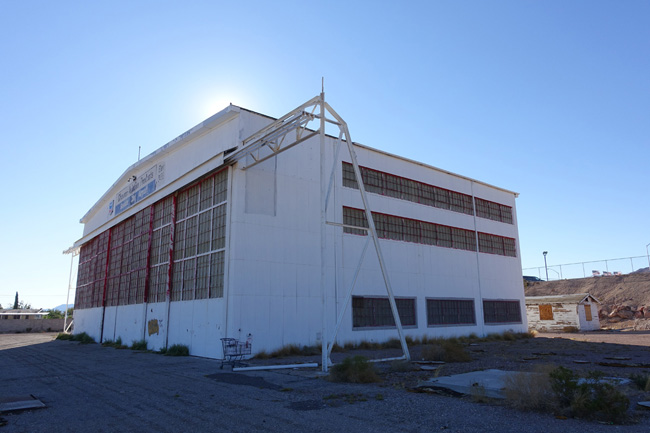
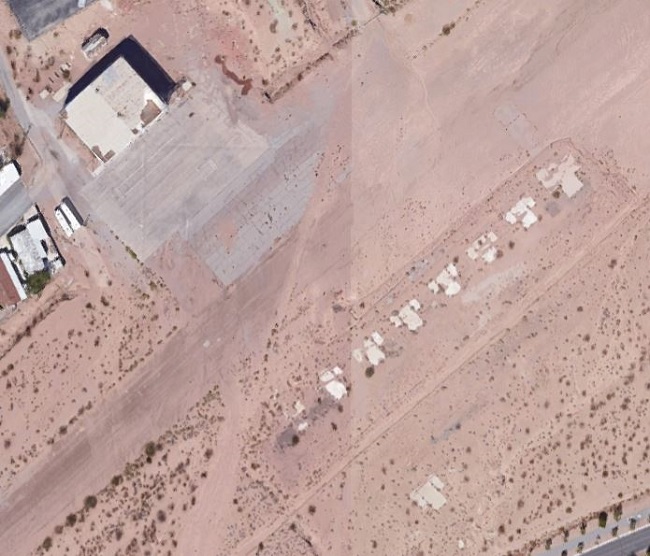
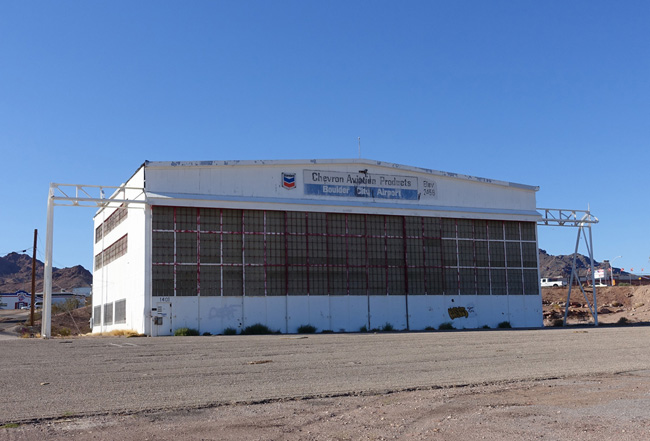
Very little remains of the original Boulder City Airport today. In the below satellite image, you can see the footprints of several small structures as well as the only remaining hangar building in the upper left corner.
Boulder City Airport in Southern Nevada
Recent satellite image of the old Boulder City Airport

At the time of my visit, the terminal building used by the navy in WWII was the only major airport structure still standing. The other buildings have been demolished or repurposed.

Historic Boulder City Airport in Southern Nevada
Jim Sullivan in front of the remaining terminal building at the historic Boulder City Airport
The terminal building is well-secured and the inside is inaccessible to the public.

Boulder City Airport in Southern Nevada

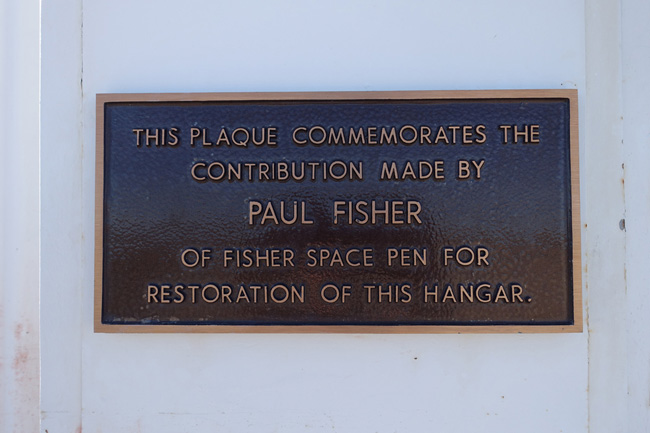
Beside the door, a plaque honors the restoration efforts of Paul Fisher, who is best known for having invented the Space Pen (which served as an important plot device in an episode of Seinfeld).
Historic Boulder City Airport in Southern Nevada

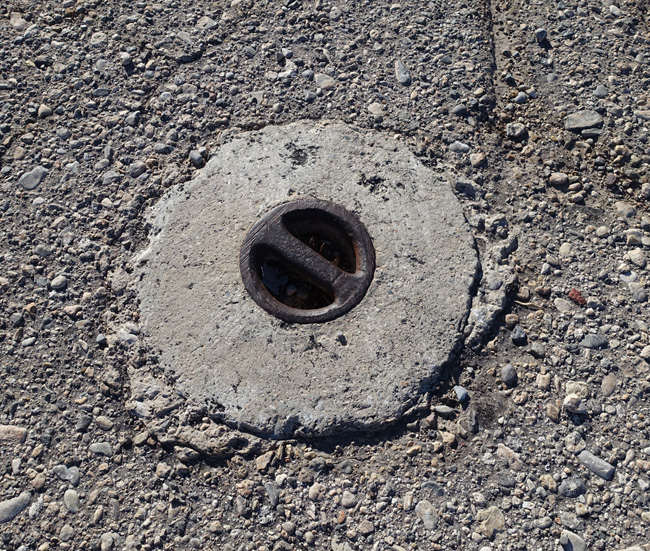
Aside from the terminal building, the only remaining traces of the airport are a shabby little boarded-up building

Boulder City Airport in Southern Nevada

Historic Boulder City Airport in Southern Nevada

and few sections of concrete from the runway.

Boulder City Airport in Southern Nevada

Historic Boulder City Airport in Southern Nevada

After my quick visit to the old Boulder City Airport, I headed into town to check out the abandoned Boulder City Hospital.

If you enjoyed this article, please feel free to share it on Facebook. While you're at it, please subscribe to Places That Were and follow me on my social media sites:

Facebook: http://www.facebook.com/placesthatwere

Google+: https://plus.google.com/u/0/+JimSullivanPlacesThatWere/posts

EyeEm: https://www.eyeem.com/u/placesthatwere

flickr: https://www.flickr.com/photos/placesthatwere/

Twitter: https://twitter.com/placesthatwere/

Youtube: https://www.youtube.com/jimplicit

Instagram: http://instagram.com/theplacesthatwere

Tumblr: http://placesthatwere.tumblr.com/

Thank you!
Boulder City Airport in Southern Nevada


Boulder City Pet Cemetery... and Alleged Mafia Burial Site

Along a desert highway in Southern Nevada lies Boulder City Pet Cemetery, an illegal graveyard with a murky past. The final resting place of hundreds of beloved pets, the sprawling stretch of land is rumored to hold the remains of a few unfortunate humans as well. 

Boulder City Pet Cemetery in Southern NV

After an unplanned stop to appreciate the ruins of Searchlight, Nevada, I continued northward through the desert toward Boulder City. A few miles outside of town, I pulled off the highway. A barbed wire fence ran parallel to the road, stretching as far as the eye could see, interrupted only by a simple white gate. Several signs warned visitors that pet burial is prohibited.

Boulder City Pet Cemetery in Southern Nevada
Sign outside Boulder City Pet Cemetery, warning visitors that pet burial is prohibited.

On foot, I slipped easily through the gate and followed a well-worn path that led to the burial plots. I was immediately awed by the complexity of the grave sites. The grieving owners had clearly spent a great deal of time and effort in building memorials to honor their beloved pets.

Boulder City Pet Cemetery in Southern NV

The oldest graves were situated in a large grid not far from the highway. They mostly consisted of wooden fences, a reminder of the picket fences that might have surrounded the yards that the dogs once called home. The fences are in rough shape, which is no surprise, considering that many of them are more than half a century old.

Many of the grave markers were missing or so badly weathered that they were no longer legible.

Boulder City Pet Cemetery in Southern NV

As I walked further into the cemetery, the grave sites became more spread out and were not arranged in the tidy grids of the earlier sites.

Boulder City Pet Cemetery in Southern NV

Boulder City Pet Cemetery in Southern NV

It is obvious that the animals buried in Boulder City Pet Cemetery knew a tremendous amount of love, and many of them lived long lives.

Boulder City Pet Cemetery in Southern Nevada

A bench had been placed near a row of graves. I imagined an elderly couple holding one another and gazing out at the mountains as they recalled fond memories of their deceased companions.

Boulder City Pet Cemetery in Southern NV

Some graves were marked by professionally engraved headstones.

Boulder City Pet Cemetery in Southern Nevada

Some even bore images of the deceased.

Boulder City Pet Cemetery in Southern Nevada

Boulder City Pet Cemetery in Southern Nevada

Others were lovingly crafted by hand.

Boulder City Pet Cemetery in Southern Nevada

Boulder City Pet Cemetery in Southern Nevada

There were even family plots.

Boulder City Pet Cemetery in Southern NV

Boulder City Pet Cemetery in Southern NV

The history of Boulder City Pet Cemetery is surprisingly difficult to pin down. According to some, the first pets were buried there in 1931. I could find no graves dating back that far, but it is possible that the markers have been destroyed or rendered illegible.

Boulder City Pet Cemetery in Southern NV

Others claim the cemetery was established in 1953 by Marwood Doud, a Boulder City veterinarian. A third rumor states that a civil engineer named Emory Lockette created the cemetery in 1953 and provided pet funeral services for $50.

Boulder City Pet Cemetery in Southern NV

Even the name is somewhat of a mystery. At the time of its inception, the cemetery occupied federal land, where burial of pets was illegal, which might explain why it was never given an official name. It is most often referred to as Boulder City Pet Cemetery, but has also been called El Dorado Valley Pet Cemetery.

Boulder City Pet Cemetery in Southern NV

In 1976, the State of Nevada requested that the Bureau of Land Management clear the land. In response, a group of local citizens formed the Incorporated Desert Pet Cemetery Association and successfully fought against the removal of the pets' graves. Further efforts to have the land officially recognized as a legal pet burial ground were unsuccessful.

Boulder City purchased the Eldorado Valley in 1995, and set aside 85,000 acres as Desert Tortoise Habitat, which meant pet burial would remain illegal. Pet burials still occur though. During my visit, I saw several grave markers with 2015 dates.

Boulder City Pet Cemetery in Southern NV

There is some speculation that the Boulder City Pet Cemetery once served as a clandestine burial ground for victims of Mafia activity in Vegas. The site is only about two dozen miles from Las Vegas, so it isn't inconceivable.

Proponents of the theory point out that it would be an ideal disposal site because no official records were kept of the cemetery's occupants, and a human grave could easily be passed off as that of a dog. It would also allow crime syndicate members to check up on the burial site without suspicion.

Speaking of rumors, Flash, the son of Rin Tin Tin, the famous TV canine cop, is said to be interred in Boulder City Pet Cemetery. I didn't happen upon his grave during my visit and cannot say whether or not the rumor is true.

Boulder City Pet Cemetery in Southern Nevada

The area is actually not very suitable for a cemetery. Coyotes are native to the region and have been known to dig up remains that were not buried deep enough. I saw evidence of this during my visit. Flash floods also sweep through the area, displacing the soil and occasionally carrying away grave markers.

Boulder City Pet Cemetery in Southern Nevada

Thank you for joining me on my Epic Rust Belt Road Trip. Be sure to come back next week, when I'll post pictures and stories from the ruins of the Boulder City Airport.

Please feel free to share this article on Facebook. While you're at it, please subscribe to Places That Were and follow me on my social media sites:

Facebook: http://www.facebook.com/placesthatwere

Google+: https://plus.google.com/u/0/+JimSullivanPlacesThatWere/posts

EyeEm: https://www.eyeem.com/u/placesthatwere

flickr: https://www.flickr.com/photos/placesthatwere/

Twitter: https://twitter.com/placesthatwere/

Youtube: https://www.youtube.com/jimplicit

Instagram: http://instagram.com/theplacesthatwere

Tumblr: http://placesthatwere.tumblr.com/

Thank you!

Boulder City Pet Cemetery in Southern Nevada

Searchlight, Nevada: A Living Ghost Town

In the arid southern corner of the Silver State lies Searchlight, Nevada. Once the site of a gold mining boom, Searchlight has become a "living ghost town," where modern structures stand alongside the ruins of historic buildings from its heyday.

Abandoned buildings in the living ghost town of Searchlight, Nevada

After a morning spent loading up the car that would serve as my home for the next 30 days, I said goodbye to Los Angeles and set my sights eastward. Months of planning had reached an end and it was finally time to set out on my epic month-long journey to explore America's Rust Belt and the abandoned places along the way.

The beautiful California sunshine, warm desert air, and the freedom of the open road filled me with a sense of peace and euphoria. John Denver's "Rocky Mountain High" poured from the stereo. I was living the dream.

Several hours later, I crossed the Nevada border and made a quick stop to refuel in the little town of Searchlight. I was still about 30 miles from my first planned stop, a huge abandoned pet cemetery outside Boulder City, Nevada.

Standing at the gas pump, a cluster of rusty old buildings down the road caught my eye and I couldn't resist taking a closer look. I had barely begun my road trip, and already I'd stumbled upon an abandoned piece of history purely by chance. I love it when that happens. 

Abandoned buildings in the living ghost town of Searchlight NV

Originally settled by prospectors in the late 1800s, Searchlight, Nevada is now home to about 500 residents, a third of whom are retirees drawn to the peace and quiet of small town life. 

Abandoned buildings in the living ghost town of Searchlight NV

Searchlight is the hometown of Senator Harry Reid, whose father was a miner. Reid is often cited as the town's foremost historian and is the author of Searchlight: The Camp That Didn't Fail. 

George Frederick Colton, a prospector from Utah, stopped in Southern Nevada on his way to the Superstition Mountains in Arizona, where he hoped to find the legendary Lost Dutchman Mine. His plans quickly changed in 1897, when he discovered gold in Searchlight. Colton immediately established a mining claim and began excavating the incredibly lucrative Duplex Mine. 

Abandoned headframe of Duplex Mine in Searchlight NV

Word of Colton's discovery spread, and in a few short years, Searchlight became a mining boom town. By 1906, over 300 mining claims had been established. Searchlight's population grew rapidly, reaching a peak of 1,500 in 1907, making it more populous than Las Vegas at the time.

Abandoned buildings in the living ghost town of Searchlight, Nevada

In 1907 the Barnwell and Searchlight Railroad was completed, linking Searchlight to important rail lines in the region.

Abandoned buildings in the living ghost town of Searchlight, Nevada

By 1917, much of the high quality ore had been excavated from Searchlight's mines. With the rising cost of gold and silver production, all but the most productive mines closed, and many people left town.

Abandoned buildings in the living ghost town of Searchlight NV

Flooding from a major storm destroyed the railroad line on September 23, 1923. Due to the declining importance of the route, the rail was never restored and became abandoned the following year.

After U.S. Highway 91 bypassed Searchlight in 1927, the town's population dropped to 50.

Searchlight experienced a temporary resurgence in the 1930s and 1940s during the construction of Hoover Dam. Workers were drawn to Searchlight for its bars, gambling and brothels. One of Searchlight's more notable brothels was The El Rey Club, which was tremendously popular in the 1940s, when prostitution was still legal in Clark County. The establishment burned down in 1950. 

Abandoned building in the living ghost town of Searchlight Nevada

The origin of Searchlight's name remains a mystery. Many explanations have been put forth, though none have been definitively proven true:
  • George Frederick Colton, while lighting his pipe with a Searchlight brand match (manufactured. by the Diamond Match Co.) discovered rocks containing flecks of gold.
  • While looking for gold in the area in 1897, Colton, in a moment of frustration, remarked that it would take a searchlight to find gold ore there.
  • Searchlights were once used to guide patrons to the brothels in area.
  • Searchlight was named after a riverboat with the same name that transported ore along the Colorado River. 
Abandoned buildings in the living ghost town of Searchlight, Nevada

Thank you for joining me on my Epic Rust Belt Road Trip. Be sure to come back next week, when I'll post pictures and stories from the eerie abandoned pet cemetery outside Boulder City, Nevada.

Please feel free to share this article on Facebook. While you're at it, please subscribe to Places That Were and follow me on my social media sites:

Facebook: http://www.facebook.com/placesthatwere

Google+: https://plus.google.com/u/0/+JimSullivanPlacesThatWere/posts

EyeEm: https://www.eyeem.com/u/placesthatwere

flickr: https://www.flickr.com/photos/placesthatwere/

Twitter: https://twitter.com/placesthatwere/

Youtube: https://www.youtube.com/jimplicit

Instagram: http://instagram.com/theplacesthatwere

Tumblr: http://placesthatwere.tumblr.com/

Thank you!

Out of the Frying Pan and Into the Rust Belt

Just shy of a year ago, I created Places That Were so that I could share pictures and stories of the many abandoned places I've explored. One of my first posts announced my Epic Exploration Road Trip of early 2015, in which I traveled through the Western United States, exploring abandoned places along the way.


I'm thrilled that so many people came to this site to join me as I recounted my journey. Thank you all so much!


Every post since then has focused on one or more of the incredible abandoned places I explored on that first road trip. The only exceptions are a few articles about sites closer to home:
-Fatalities and Films of a Ghostly Movie Ranch in Acton, CA
-The Mystery of Canned Heat House
-Abandoned Water Park in the Mojave Desert - Lake Dolores aka Rock-A-Hoola


Those of you who follow my social media feeds probably know that I took a month-long road trip last fall, my Epic Rust Belt Road Trip of 2015 (#RustBeltRoadTrip2015). I drove from Los Angeles to the Rust Belt (formerly known as the Manufacturing Belt), to explore the abandoned ruins of the former industrial powerhouses that once epitomized American ingenuity and prosperity.

It was mind-blowing to see how cities such as Detroit, Cleveland, Gary, Youngstown, and Akron, which flourished in the early and mid-1900s, have plunged into severe economic ruin. Urban centers that once embodied the American Dream now resemble war-torn cities of the Third World.


It must have been heartbreaking to watch helplessly as automakers and other industrial giants turned their back on American workers and moved their manufacturing overseas to take advantage of cheap wage standards and nonexistent labor protection laws.


I had recently been laid off from the job I loved, so exploring the Rust Belt was a deeply symbolic experience for me. Years of hard work, professional accomplishments, and personal sacrifice become suddenly irrelevant when a company makes cost-cutting its highest priority.


I have a great deal of empathy for the Rust Belt's Places That Were. In a society that often defines people by what they do for a living, I felt like a Person That Was.


Compelled to pay respect to the Rust Belt's historical places, I was on a mission to document what has become of them, and hopefully gain some insight into what we can do to make things better.


Being away from my better half for an entire month was not easy, but I had no choice. This was my last great opportunity to do what I love most. I knew that when I returned home, I would need to resume my career, which means I'll never again have time for a cross-country road trip until I retire.


After weeks of intense research and planning, I hit the road and began what would be the greatest adventure of my life so far. 

Below is a rough map of my route:


I would drive from Los Angeles to Cleveland, spending a day or two in each state along the way to check out ghost towns, factories, hospitals, military installations and other deserted sites. After several days exploring the incredible abandoned places in Cleveland, I'd head to Detroit for a week. There are so many awesome urban ruins in Detroit, it would take months to explore them all. I'd have to be satisfied with the several dozen explorations I could squeeze into my week-long visit. 


From Detroit, I'd head westward along a northern route, gradually making my way back to California. My final destination was an art gallery opening in Oakland, where one of my photos from the earlier road trip would be on display. It was the first and only time any of my work has been featured in a gallery, and it made for the perfect end to an incredible journey. 


I spent most of the month driving, exploring, or resting and was not able to post many updates online, but here is a video I posted from the road: http://www.placesthatwere.com/2015/09/rust-belt-road-trip-2015.html and another I made after I returned home: http://www.placesthatwere.com/2015/10/rust-belt-road-trip-update.html


I hope you all will come back and visit Places That Were over the coming months as I share stories from my Epic Rust Belt Road Trip.


Thanks again for joining me. Please feel free to share this article on Facebook. While you're at it, please subscribe to Places That Were and follow me on my social media sites:

Facebook: http://www.facebook.com/placesthatwere

Google+: https://plus.google.com/u/0/+JimSullivanPlacesThatWere/posts

EyeEm: https://www.eyeem.com/u/placesthatwere

flickr: https://www.flickr.com/photos/placesthatwere/

Twitter: https://twitter.com/placesthatwere/

Youtube: https://www.youtube.com/jimplicit

Instagram: http://instagram.com/theplacesthatwere

Tumblr: http://placesthatwere.tumblr.com/

Thank you!